Intel unleashes Xeon 6+ processors and Intel Ethernet E835
Intel Corporation announced a series of critical data center infrastructure advancements. The comprehensive release includes the official rollout of the new Intel Xeon 6+ processors, a major expansion of the 800 Series Ethernet portfolio featuring the Intel Ethernet E835 controllers and network adapters, and critical operational updates regarding its AI accelerator roadmap, specifically focusing on the upcoming Crescent Island discrete graphics hardware. Together, these engineering developments mark a defined structural transition across enterprise landscapes; as generative artificial intelligence workloads evolve to become more autonomous and agentic, the Central Processing Unit (CPU) is reemerging at the center of infrastructure as a critical plane for data orchestration and movement.
Architecture of the Intel Xeon 6+ Processors
The Intel Xeon 6+ processors expand the current Xeon 6 architecture family, focusing on raw performance density, operational power efficiency, and macro-scale deployment for cloud-native, telecom, and network-intensive enterprise workloads. Built on the advanced Intel 18A process node—marking its inaugural implementation inside a data center CPU—the Xeon 6+ line is engineered to maintain sustained performance metrics within strict institutional power constraints. The architecture targets environment footprints optimized for throughput per core and predictable low-latency scale-out execution.Technical highlights of the Xeon 6+ processors include:
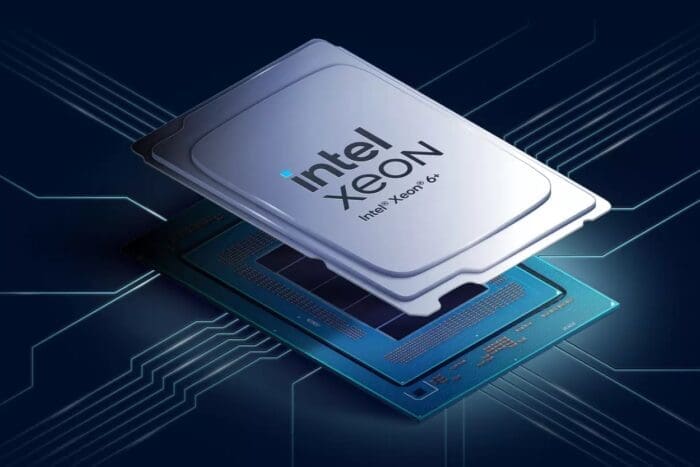
- Massive Core Integration: Integrates up to 288 Efficient-cores, driving up to a 2.5 times performance increase compared to previous-generation hardware architectures. It delivers up to a 45% improvement in performance per thread per watt against competing industry products, guaranteeing concurrency and rapid responsiveness for network-heavy data models.
- Bandwidth and IO Interconnects: Implements 12-channel DDR5 memory subsystems to provide scalable, high-density system bandwidth. It features 96 discrete lanes of PCIe Gen 5 interconnectivity alongside comprehensive Compute Express Link (CXL) architectural support to accelerate heterogeneous data transfers.
- Workload Energy Telemetry: Introduces Intel Application Energy Telemetry (AET), a silicon-level framework that enables real-time, workload-level CPU energy and structural activity telemetry to optimize rack power allocation. The design enables a high 9:1 server consolidation ratio, lowering the total cost of ownership (TCO) compared to 2nd Gen Intel Xeon infrastructure.
- Silicon-Embedded Protection: Incorporates native security boundaries built directly into the underlying silicon layout, featuring Intel Software Guard Extensions (Intel SGX) and Intel Trust Domain Extensions (Intel TDX) to govern multi-tenant cloud operations.
High-Efficiency Networking via Intel Ethernet E835
As modern distributed workloads scale, network fabric configuration determines overall compute infrastructure performance and efficiency. The Intel Ethernet E835 controllers and adapters are engineered to deliver performant connectivity across virtualized enterprise cloud, edge, and AI environments. The E835 architecture reduces energy consumption and operational expense without compromising data throughput or transactional reliability.Key technical highlights of the E835 networking portfolio include:
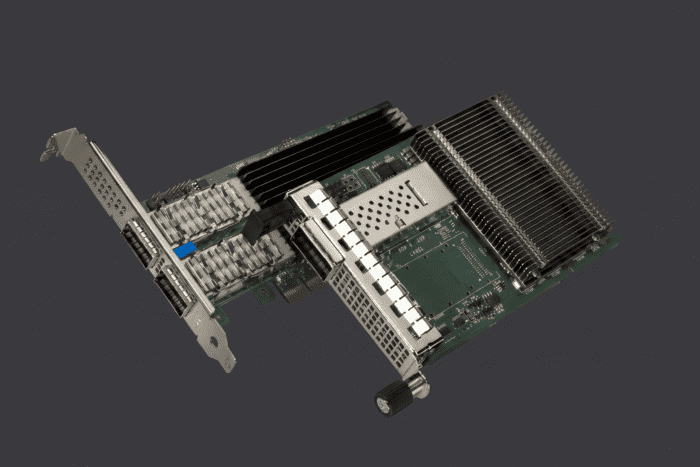
- Adaptive Port Layouts: Delivers up to 200 GbE throughput via versatile controller and adapter footprints supporting line rates from 10GbE to 200GbE. Supported physical layouts feature 2x25GbE, 4x25GbE, 2x100GbE, and 1x200GbE, with customized mapping enabled via the Intel Ethernet Port Configuration Tool (EPCT).
- Power-Per-Watt Leadership: The Intel E835-CQDA2 network adapter delivers up to 1.9 times higher performance per watt than the comparable NVIDIA ConnectX-6 DX (CX614106A) card and 1.4 times higher than Broadcom’s BCM957508-P2100G unit, reducing baseline data center cooling costs.
- Network Acceleration and Offloading: Implements remote direct memory access protocols via RDMA (RoCEv2/iWARP) to minimize CPU cycle overhead , alongside Dynamic Device Personalization (DDP) to accelerate packet processing pipelines.
- Long-Term Lifecycle: The platform supports multiple enterprise operating systems—including Linux, ESXi, and Windows —and is backed by a 10+ year product lifecycle commitment.
Enhanced Performance for SMB Entry Servers
Intel also announced the immediate availability of a new 12-core product variant within the Intel Xeon 6300 processor line, breaking past the historical 8-core maximum ceiling for entry-level servers for the first time. The expanded core layout delivers added raw computing density and application flexibility for growing small and mid-sized business (SMB) operations without demanding expensive platform architecture modifications. The drop-in compatible processors are available today through major Original Equipment Manufacturers (OEMs) to facilitate cost-effective server room upgrades.
AI Inference Acceleration via Crescent Island GPUs
To meet memory capacity and bandwidth boundaries required by agentic AI, Intel disclosed detailed specifications for its next-generation data center GPU family, code-named Crescent Island. Built on the advanced Xe 3P architecture, the silicon upgrades the established Xe footprint to achieve elevated performance-per-watt metrics while retaining deep ecosystem software compatibility for enterprise AI models.
Crescent Island is equipped with ultra-fast LPDDR5x memory subsystems, delivering up to a massive 480 GB of onboard memory capacity to manage large, token-intensive workloads locally while reducing hardware acquisition costs. The platform runs inside a highly efficient 350W air-cooled PCIe card form factor, enabling data center operators to deploy dense scaling configurations without fluid cooling dependencies.
The discrete GPU offers wide-ranging data-type compatibility, supporting formats from native FP4 and micro-scaling MXFP4 up to high-precision FP64 applications without compromise. Intel’s open, programmable AI software stack minimizes development friction by facilitating out-of-the-box optimization for model pipelines. Leveraging the common Xe architectural baseline, the Intel Arc Pro Series serves as a standard localized hardware sandbox, allowing software developers to build, validate, and tune AI models seamlessly with backward and forward compatibility for target Crescent Island data center deployments.
“AI doesn’t scale as a collection of parts—it scales as a coordinated system,” said Kevork Kechichan, Executive Vice President and General Manager of the Intel Data Center Group. He emphasized that as machine ecosystems shift toward agentic frameworks, compute limitations concentrate on systemic orchestration, task concurrency, and multi-node data movement. This evolution validates a foundational enterprise reality: the CPU remains the master control plane for modern AI clusters.