
New report: AI raises telemetry pressure in UAE and Saudi organizations

AI is increasing the volume of telemetry that organizations must manage in the UAE and Saudi Arabia, according to Dynatrace’s State of Observability 2026 report. The study found that 46% of UAE respondents and 43% of Saudi respondents said AI has increased telemetry data volumes, compared with 33% globally.
The findings also point to different operational challenges in the two markets. In the UAE, only 32% of respondents said observability has helped their organizations detect and resolve issues faster, compared with 52% globally. In Saudi Arabia, 35% of security respondents said they fully remediate critical vulnerabilities within 24 hours, versus 28% globally.
Dynatrace said the growing use of AI creates a distinction between systems that are technically available and responsive and systems that are actually behaving as intended. The report identifies gaps across AI quality, agent behavior, security, cost, and business impact.
AI agents are moving faster than governance
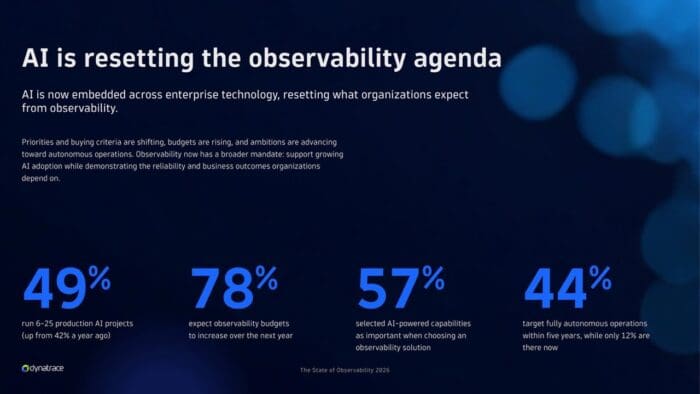
Globally, 87% of respondents said their organizations use AI agents for observability and IT operations. At the same time, 44% said they aim to reach fully autonomous operations within five years, compared with 12% that report reaching that level today.
Despite that ambition, respondents said humans still verify an average of 66% of AI-powered decisions. Only 27% currently address visibility into how AI agents make decisions and take action.
Across nine AI observability capabilities measured by the research, implementation trails perceived importance by an average of 14 percentage points. Dynatrace said this reflects a broader execution gap as organizations give AI agents more responsibility before they can fully explain how those agents reach decisions.
The report distinguishes between two capabilities: observability of AI, which focuses on evidence about AI behavior, quality, security, cost, and impact, and AI-powered observability, which applies causal analysis, automation, and agents to broader IT operations.
UAE organizations face pressure from AI behavior and data complexity
In the UAE, 49% of respondents said unpredictable AI application and model behavior has added complexity, while 45% identified multi-cloud environments as another source of complexity.
Only 32% said observability has helped them detect and resolve issues faster, compared with 52% globally. A further 33% said observability has helped move AI projects from pilot to production.
The study also found pressure on UAE security teams. Some 38% said they miss their own targets for remediating critical vulnerabilities, the highest proportion among the 12 markets surveyed.
Additional UAE findings show that 35% said AI has increased the skills required to manage observability. Meanwhile, 40% identified the cost of storing, processing, and retaining observability data as a challenge, and the same share cited integrating data from multiple sources.
On vulnerability remediation, 31% of UAE respondents said critical vulnerabilities take an average of one to four weeks to fully remediate, while 8% set a remediation target longer than one month.
Saudi Arabia reports lower AI complexity but growing monitoring demands
In Saudi Arabia, 25% of respondents said AI has made their technology environment more complex, compared with 49% globally. However, 43% said AI has increased the number of monitoring tools required.
The main data-related concern in Saudi Arabia is governing sensitive or regulated data within observability pipelines, cited by 37% of respondents. The cost of observability data was cited by 24%, while 19% pointed to managing log volumes.
Saudi respondents reported stronger results in some areas. Some 48% said observability has helped accelerate AI projects from pilot to production, while another 48% said it has supported better-informed business decisions.
Security teams also reported faster vulnerability remediation. Some 35% said critical vulnerabilities are fully remediated within 24 hours on average, while 40% set a 24-hour remediation target.
Global observability budgets continue to rise
Globally, 78% of respondents expect observability budgets to increase. Among those expecting higher spending, 96% said AI adoption is at least a moderate driver of that increase.
The research also found that 43% consider the expansion of AI, large language models, and agentic workloads a leading source of technology complexity.
Visibility into AI-agent decisions remains a notable gap. While 43% consider this capability important, only 27% said they currently address it.
Security remains another concern, with 55% of security respondents globally saying they experienced a zero-day incident during the previous year.
OpenTelemetry adoption is also advancing. Dynatrace found that 77% have moved OpenTelemetry beyond the evaluation stage, while 20% now treat it as a strategic standard.
Dynatrace argues that context-aware observability can help technology leaders connect AI behavior with surrounding systems, risks, costs, and business outcomes, giving organizations a stronger basis for deciding where to expand AI use, where greater autonomy is appropriate, and where intervention is needed.