Beyond GPUs: Why data Is becoming the real infrastructure of AI

At NetApp INSIGHT 2026, CEO George Kurian made the case for an enterprise AI future in which models and compute are only part of the equation. Increasingly, the differentiator is the data behind them.
For much of the generative AI boom, the infrastructure conversation has revolved around compute. The industry raced to secure GPUs, build larger clusters, and create AI factories capable of training and running increasingly demanding models. That investment is not slowing down. However, as companies move from experimentation into production, another constraint is becoming harder to ignore: their own data.
That was one of the clearest themes to emerge from a media roundtable with NetApp CEO George Kurian during NetApp INSIGHT 2026 in Las Vegas.
The discussion went well beyond storage capacity or infrastructure performance. At its core, there was a more important question: what happens when enterprises try to turn years of proprietary information into data that AI can actually understand, trust, and act on?
From AI experiments to operational AI
A proof of concept can be relatively controlled. A team selects a dataset, prepares it, connects a model, and measures the result.
Production AI is different
An enterprise system may need to work across documents, databases, applications, and file systems accumulated over years. Some of that information will be current and useful; some will not. Access rights vary: sensitive data must remain protected. And the information itself is rarely sitting neatly in one environment.
That challenge becomes more important as the industry moves toward agentic AI. A chatbot using poor context may produce a poor answer. An AI agent could use that same context to make a decision, interact with another system, or initiate an action. At that point, data quality, governance and permissions are no longer simply back-office concerns. They become part of the AI architecture itself.
NetApp describes today’s enterprise data estates as fragmented across file, object, cloud, on-premises, and sovereign environments, often relying on pipelines that copy and transform information before it can be consumed by AI. The company argues that this introduces latency, cost, and governance complexity.
The important shift is that AI readiness is becoming less about whether an organization has access to a capable model and more about whether it understands its own data well enough to use that model effectively.
NetApp’s biggest AI bet
When MENA TECH asked Kurian what he considers the biggest bet NetApp is making for the AI era, the question went to the heart of the company’s broader transformation.
NetApp has spent decades being identified primarily as an enterprise storage company. Its current strategy is considerably broader: to position the data layer itself as a foundation for AI.
The company’s AI Data Engine is one example. NetApp says it can discover and understand data across ONTAP, StorageGRID, and non-NetApp environments, including NFS, SMB, and S3 repositories, with the aim of making existing enterprise information usable for analytics and AI without first moving everything into another dedicated data store.
The product matters, but the change underneath it is more significant. Traditionally, enterprise storage has been judged largely through metrics such as capacity, availability, latency, resilience and cost.
AI adds another requirement: context
It is no longer enough to know where information resides. AI increasingly needs to understand what that information means, how it relates to other information, whether it is current, who is entitled to access it and whether it can be trusted.
That pushes metadata, governance, and semantic understanding closer to the infrastructure layer. Moreover, this is where NetApp’s strategic argument becomes interesting. The company is effectively betting that the storage layer will evolve from simply holding enterprise data into helping make that data intelligible and usable by AI.
GPUs are only useful when the data keeps up
The same problem appears differently at the other end of the AI market. AI factories are making extraordinary investments in accelerated computing, but the economics of those investments depend on utilization. A GPU waiting for data remains expensive infrastructure that is not doing productive work.
NetApp says that under some traditional architectures, GPU utilization can fall below 30 percent when storage cannot supply enough data to the compute layer. That is the company’s own assessment, but the broader infrastructure issue is straightforward: as GPU environments scale, everything around them has to scale as well.
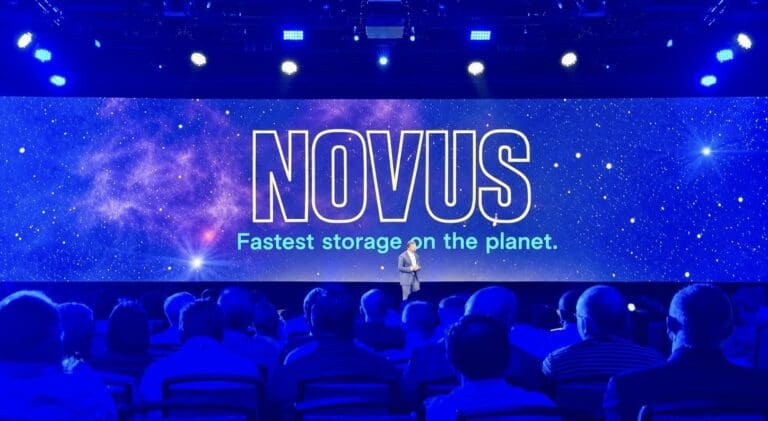
This is the context for NetApp Novus, announced at INSIGHT for large AI factories and GPU-as-a-Service providers. Novus separates metadata management from the primary data path, allowing metadata, bandwidth, and capacity to scale independently within a single namespace. NetApp says the architecture is built to exceed 100 TB per second of aggregate throughput.
The figure attracts attention, but the economic argument is more interesting. For much of the past two years, the AI infrastructure race has focused on acquiring more GPUs. As those environments grow, the industry is being forced to pay more attention to how effectively that compute is used.
Where will enterprise data actually live?
A second question MENA TECH put to Kurian looked further ahead: over the next three to five years, will enterprise data shift toward public cloud, move back on-premises, or settle into an increasingly hybrid model?
The industry has spent years debating cloud versus on-premises infrastructure, but AI is making the answer less binary. Large enterprises increasingly operate across several environments at once. Public cloud makes sense for some applications. Private infrastructure remains attractive where performance, cost predictability, or control matters. Regulation is also pushing certain workloads toward sovereign and locally controlled environments.
The result is not one destination for enterprise data, but a more distributed architecture. NetApp’s planned service with Oracle is a useful example. Oracle Cloud Infrastructure NetApp Storage Service is designed to bring ONTAP data-management capabilities natively into OCI for databases, enterprise applications, HPC, and AI data pipelines.
More importantly, NetApp says the service is intended to provide consistent data management, security, availability, and performance between cloud and on-premises environments.
Viewed narrowly, it is another cloud integration. Viewed in the context of AI, it reflects something more important: enterprise data is likely to remain distributed even as AI applications increasingly expect seamless access to it. Solving that contradiction may become one of the defining infrastructure challenges of enterprise AI.
Beyond storage
This explains why NetApp increasingly describes itself as an “Intelligent Data Infrastructure” company rather than simply a storage vendor. Corporate repositioning always comes with marketing language, and that description should be judged by what the company actually delivers. But the broader market shift behind it is real.
Storage, metadata, cyber resilience, governance, data mobility, and AI preparation are becoming harder to treat as separate disciplines. NetApp’s platform strategy is built around that convergence: connecting, protecting, and activating data across workloads and environments, with ONTAP as the foundation and newer intelligence services layered above it.
Whether NetApp succeeds in owning that layer will ultimately be decided by customers and competition. But the underlying premise is increasingly difficult to dismiss. The first stage of the generative AI race was about models. The second became a race for GPUs and compute.
As AI moves into production, the differentiator is shifting again. Models are increasingly accessible. Compute can be bought, rented or consumed as a service. What remains unique to every enterprise is its own data: customer relationships, operational history, intellectual property, business processes, and accumulated institutional knowledge.
The challenge is turning that information into something AI can safely understand and use. That may prove harder than buying another cluster of GPUs. And ultimately, far more valuable.