Dyson CameraJet Combines an AI Camera and Liquid Flossing in One Toothbrush
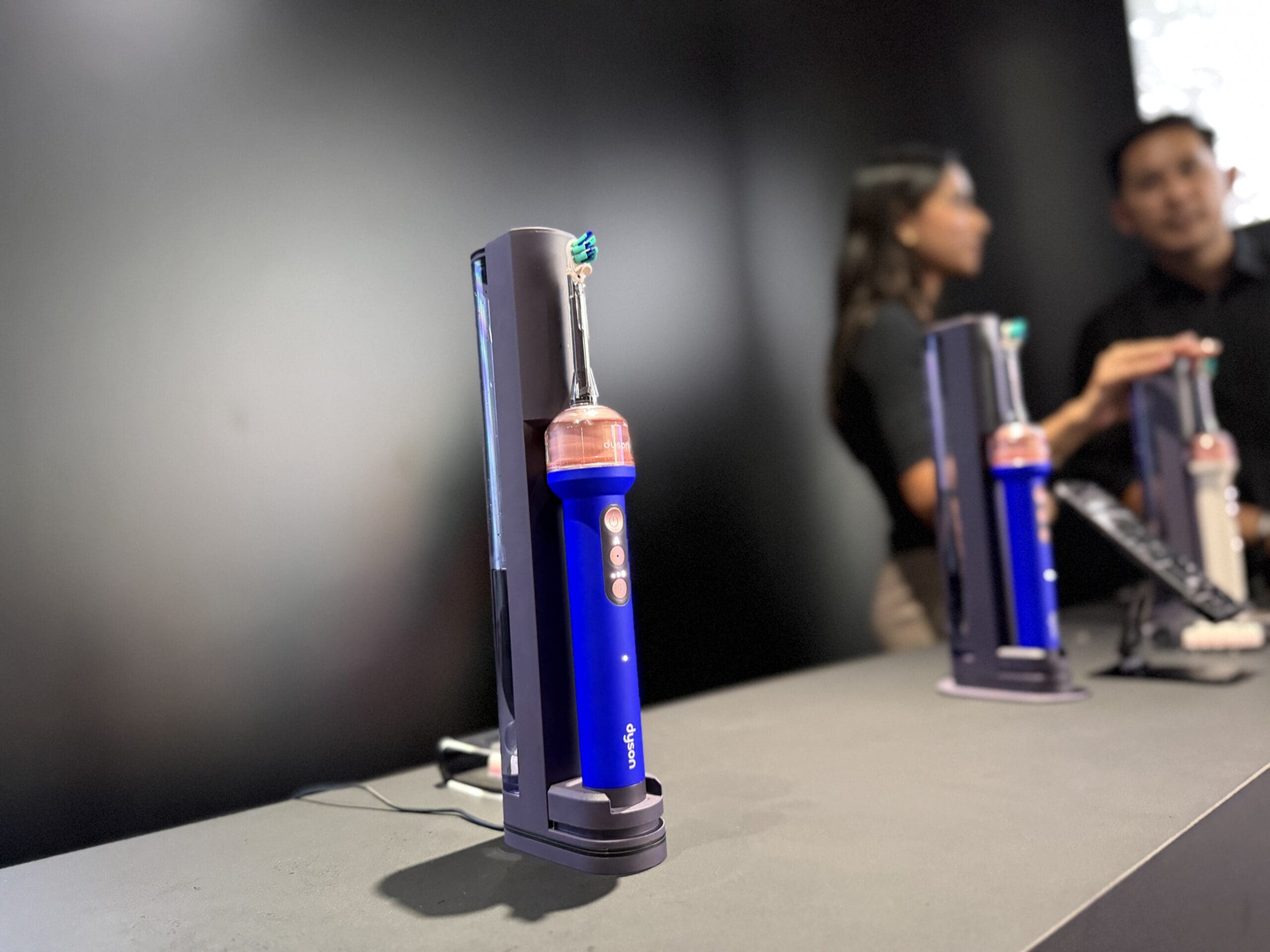
The most unexpected machine at Dyson Unveiled was not a vacuum or a hair tool, but a toothbrush. On stage and on the event floor, Dyson presented CameraJet as an attempt to combine brushing, liquid flossing and live guidance in one connected device.
The Dyson CameraJet toothbrush uses a small camera and machine learning to identify spaces between teeth. When it detects a gap, the system can direct a controlled burst of mouthrinse towards it while the user continues brushing. MENATECH also saw the device’s refill dock and both launch colourways at the Berlin showcase.
Dyson says CameraJet will reach Dyson Demo Stores and selected retailers in the UAE and Saudi Arabia in September. The full system costs AED 1,949 in the UAE and SAR 1,949 in Saudi Arabia and will be sold in Ceramic Ultra Blue and Ceramic Pink.
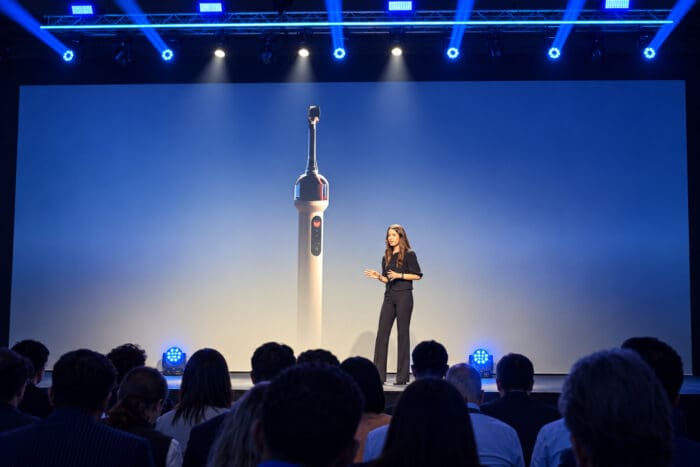
Dyson presented CameraJet as the centrepiece of its intelligent-machines showcase in Berlin. Photo: MENATECH.
How the Dyson CameraJet toothbrush spots gaps
At the centre of CameraJet is a 100,000-pixel macro camera paired with Dyson’s Gap Optical Targeting system. Dyson says the camera analyses 28 live images per second, identifies and tracks interdental gaps, and can trigger a conical burst of mouthrinse within 100 milliseconds of seeing one.
The company says the machine-learning model was trained on more than 470,000 dental images. CameraJet runs on 16 million lines of code, while 661 engineers worked on the product over six years, resulting in 38 patent filings, according to Dyson.
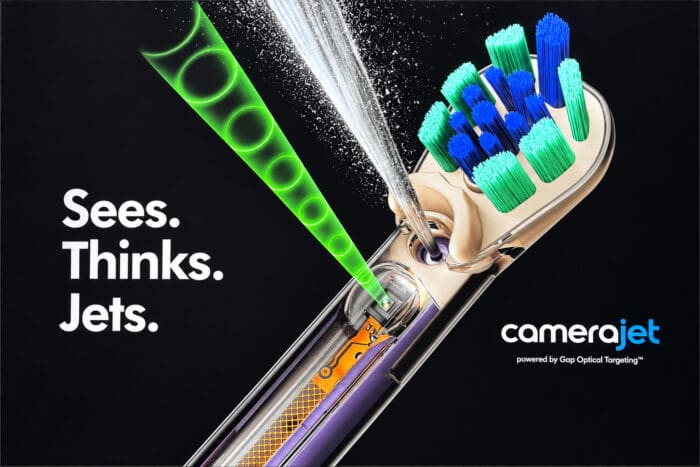
An event display shows how CameraJet combines gap detection with a targeted mouthrinse jet. Photo: MENATECH.
The camera can also provide a live view through the MyDyson app. Dyson says it operates only during live viewing or automatic jetting and that images are not recorded or stored on the toothbrush or in the cloud. The app adds guided cleaning, coverage maps, session insights and personalised feedback.
“Flossing is an awkward and time-consuming chore. Few of us do it even though we know we should.”
— James Dyson, founder and chief engineer
A jet designed to sweep rather than pierce
CameraJet’s liquid-flossing system uses a broad conical spray instead of the narrow stream common to many water flossers. Dyson says the wider profile is designed to sweep plaque away at lower pressure and be gentler on gums and enamel. That performance statement comes from Dyson laboratory tests using a proxy plaque developed during a five-year research collaboration with the National University of Singapore’s Faculty of Dentistry.
A 12.5-millilitre reservoir holds the mouthrinse for one cleaning session. A diaphragm pump and pressure chamber are designed to keep the jet working when the handle is tilted or held horizontally, including while cleaning the backs of the teeth.
The charging dock doubles as a refill station and can replenish the mouthrinse tank in three seconds, according to Dyson. The package includes a travel case, toothpaste and mouthrinse. Dyson developed lower-foaming formulations so bubbles do not obstruct the camera.
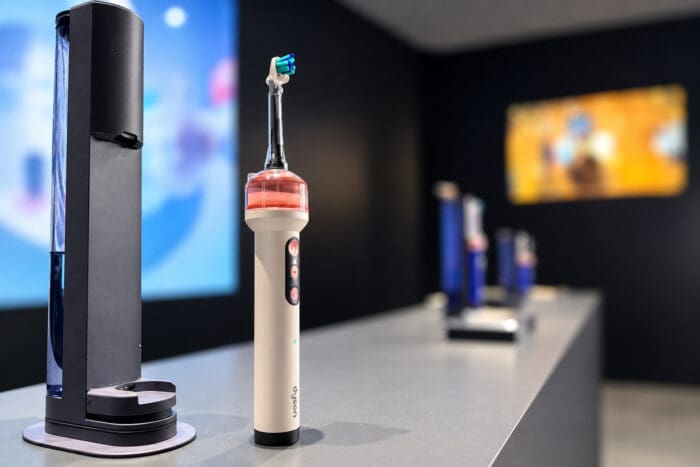
The Ceramic Pink CameraJet and its charging-and-refill dock on the Dyson Unveiled show floor. Photo: MENATECH.
Dyson also reworked the brush head
CameraJet uses a contoured dual-bristle head, with firmer inner bristles for surface stains and softer outer bristles along the gumline. An RFID tag in each head allows the device to track use and alert the owner when replacement is due.
Dyson also developed variable sonic oscillation. Rather than moving at one fixed angle, the head changes its oscillation to help keep bristles moving when they press against difficult surfaces. Dyson says laboratory testing found that this approach removed up to 69% more plaque in hard-to-reach areas than market-leading premium electric toothbrushes. This is a manufacturer claim, not independent clinical guidance.
What CameraJet is trying to change
The product’s pitch is behavioural as well as technical. Dyson argues that many people skip flossing, brush for less than the recommended two minutes and miss the spaces between their teeth. The World Health Organization estimates that oral diseases affect nearly 3.7 billion people worldwide.
CameraJet tries to make those missed spaces visible and to bring flossing into the brushing routine. Whether the camera-and-jet approach improves long-term oral-health outcomes will depend on sustained real-world use and independent evidence beyond Dyson’s launch testing. Even so, it is a notable expansion for a company better known for floor care, air treatment and hair technology.