What CIOs get wrong about best-of-breed vs. unified AI infrastructure

Every AI strategy today hinges on a core infrastructure question. As AI initiatives transition from testing to large-scale enterprise deployment, architectural stakes are rising. Leaders are shifting their focus from models to the systems that enable them. The central question: build on a best-of-breed architecture, or commit to a fully integrated, unified stack?
This is not a routine IT decision; it directly influences agility, governance, operational costs, and long-term competitiveness. A recent AMD report indicates that most enterprises are managing five to seven AI initiatives simultaneously, encompassing automation, analytics, and generative applications. In such a multi-project environment, infrastructure complexity compounds quickly. What appears manageable during a pilot phase can become complex and costly when scaled across multiple workloads.
What “best-of-breed” really means
The phrase “best-of-breed” is often misunderstood. In AI infrastructure, it means choosing the optimal technology for each layer of the stack—compute, networking, storage, and orchestration—based on specific requirements, regardless of vendor alignment. Instead of adhering to a single ecosystem, organizations build a custom architecture composed of the most capable components for each task.
Best-of-breed strategies are often chosen to maximize flexibility and tailor infrastructure to specific workloads. Enterprises following this approach seek the most powerful accelerators for AI training, efficient CPUs for orchestration, advanced networking fabrics for east–west data transfer, and storage systems calibrated for high-throughput pipelines.
The appeal is clear. This model enables experimentation and rapid adoption of emerging technologies. It reduces dependence on a single vendor’s roadmap and enables IT teams to maintain strategic autonomy. For organizations that prioritize innovation and differentiation, best-of-breed architectures offer compelling advantages.
However, integration across multiple vendors can increase deployment complexity. Specialized expertise is needed to manage heterogeneous environments. Governance and security enforcement become more difficult when policies must cover fragmented systems. What starts as architectural freedom can quickly translate into operational strain if not carefully managed.
The case for unified infrastructure
On the other side of the spectrum lies the unified AI infrastructure model. Unified architectures are pre-engineered, full-stack solutions designed to integrate seamlessly from hardware to orchestration. Instead of selecting and assembling components individually, enterprises adopt an integrated platform optimized for cohesion.
Organizations often gravitate toward unified systems because they lower friction. Deployment times are shorter, integration risks are reduced, and security policies can be enforced consistently across the entire stack. In regulated industries or large-scale environments, where speed and governance are essential, this operational simplicity is strategically compelling.
Yet unified systems come with their own set of trade-offs. Reduced flexibility may limit the ability to incorporate emerging technologies. Ecosystem dependence can constrain long-term adaptability. Over time, enterprises may find themselves tied to vendor roadmaps that do not align with their innovation cycles.
The problem with binary framing
The real tension between best-of-breed and unified approaches arises around three main friction points: security, scalability, and integration complexity. Balancing innovation with security and compliance is difficult on its own; add in avoiding vendor lock-in and scaling AI workloads from pilot to production, and the decision becomes even more complicated.
As AI portfolios expand across multiple concurrent initiatives, inconsistencies in networking architecture, compute allocation, and policy enforcement become more visible. Fragmentation heightens risk, while over-standardization can hinder innovation. CIOs are often told they must balance these conflicting forces, but the choice is not either-or.
The right strategy depends on enterprise goals, AI maturity, and tolerance for complexity. However, few enterprises operate consistently at one extreme. AI workloads vary significantly. A generative training cluster in the data center does not impose the same architectural requirements as real-time inference at the edge.
Rather than treating best-of-breed and unified systems as mutually exclusive, leading enterprises are integrating them by standardizing core operational layers while preserving flexibility where innovation is most critical. This hybrid model recognizes that AI workloads differ in compute intensity, governance requirements, and performance expectations. By aligning infrastructure decisions with workload characteristics, organizations can balance agility and control. Core security frameworks and orchestration layers remain unified, while specialized components are introduced where performance optimization is critical.
Bridging flexibility and integration
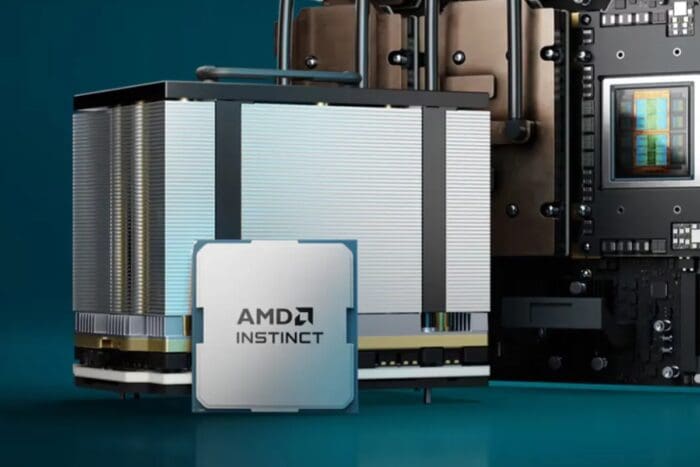
Whether enterprises choose best-of-breed, unified infrastructure, or anything in between, AMD provides a broad portfolio of hardware and software within an open ecosystem that supports both customization and cohesion.
Rather than forcing organizations into a closed, single-path architecture, AMD supports open standards and interoperability, including open-source software (AMD ROCm™ Software), open hardware interconnects (UALink), and open rack architectures (OCP). This approach enables collaboration across hardware vendors, software providers, and cloud environments, allowing enterprises to integrate emerging technologies, avoid vendor lock-in, and align infrastructure decisions with workload requirements rather than ecosystem constraints.
At the same time, AMD offers coherent, full-stack solutions, from silicon to systems. At the hardware level, the company offers AMD EPYC™ server CPUs and AMD Instinct™ GPUs, complemented by the AMD Enterprise AI Suite at the software level. This interconnected ecosystem simplifies orchestration, can improve power-efficiency, and accelerates deployment across hybrid environments.
Enterprises that prefer unified operational models can standardize on AMD integrated platforms. Those pursuing best-of-breed strategies can selectively optimize specific workload layers. For others adopting hybrid architectures, AMD provides the flexibility to blend both approaches without sacrificing governance or efficiency.
In this era, enterprise AI adoption success depends on balancing integration with openness, and operational simplicity with room to evolve. The future of AI infrastructure isn’t limited to two extremes; it spans a spectrum of options that benefit from the open, comprehensive ecosystem AMD offers.