
Architecting for value: how can enterprises realise enduring AI ROI

As enterprises move from AI experimentation to industrial-scale deployment, a critical realization is emerging: infrastructure strategy is inseparable from economic results. For years, artificial intelligence initiatives lived primarily in innovation labs and pilot programs. They were exploratory by nature, proofs of concept designed to test feasibility rather than deliver enterprise-wide impact. That phase is ending.
AI is now becoming embedded directly into core business functions: supply chains that optimize in real time, customer service systems that resolve inquiries autonomously, financial modeling engines that spot anomalies before risk escalates, and product design workflows augmented by intelligent simulation.
With this shift comes a new mandate. AI systems are no longer judged solely by technical novelty or model accuracy. They are evaluated by measurable business outcomes, such as margin improvement, process efficiency, revenue growth, and competitive differentiation. And increasingly, organizations recognize that these outcomes are shaped not only by the models themselves but also by infrastructure decisions made long before deployment. In AI, architecture is economics.
One size does not fit all
Headlines about trillion-parameter models and sprawling GPU clusters often dominate the modern AI narrative. While these advances represent meaningful technical progress, they do not define every enterprise use case.
Not every AI workload requires hyperscale generative systems. Business-critical applications such as predictive maintenance, fraud detection, classification systems, and forecasting engines can operate effectively on lighter machine learning architectures with lower compute requirements. These systems regularly deliver strong returns precisely because they are purpose-built and tightly aligned to a defined operational objective.
When organizations automatically equate AI maturity with ever-larger parameter numbers and ever-expanding infrastructure, cost structures can quickly become distorted. Overprovisioning compute for workloads that do not require it erodes ROI before value is realized.
Purpose-fitting infrastructure begins with disciplined evaluation. What level of complexity does the use case demand? What is the acceptable latency? What degree of accuracy meaningfully improves outcomes? Answering these questions is key to kick-starting any AI project.
Infrastructure needs vary widely by model type. Traditional machine learning models may run efficiently on CPU-based environments. Fine-tuned generative models may require moderate GPU clusters for training and inference. Agentic AI systems demand more sophisticated orchestration layers and memory management strategies. When infrastructure is matched precisely to workload requirements, efficiency becomes a competitive advantage rather than a constraint.
The variables that shape cost

Multiple interdependent variables shape the economics of AI infrastructure. Understanding their interaction is essential for forecasting the total cost of ownership and defending investment decisions. A recent white paper by IDC1outlined these variables as:
- Model type plays a core role. Generative and agentic systems inherently entail higher computational requirements than classical machine learning approaches due to their architectural complexity and inference patterns.
- The number of parameters greatly affects training cost. Larger models require more parallel compute capacity and longer processing cycles, particularly during pretraining.
- Training data volume expands storage and networking requirements. Huge datasets increase I/O and compute demands, requiring robust data pipelines and sufficient processing power to prevent bottlenecks.
- Accuracy thresholdscreate nonlinear cost dynamics. Pushing precision closer to the theoretical maximum frequently requires exponentially more compute. Some use cases need such high precision, but most do not.
- Time-to-value expectations also alter infrastructure design. Aggressive timelines may require greater parallelization and higher peak compute allocations to compress training windows.
- Query response time becomes critical for customer-facing systems. Low-latency requirements drive architectural decisions around memory optimization and hardware placement.
- Concurrency and query size influence scaling requirements. High user volumes or multimedia inputs increase memory bandwidth and processing requirements, particularly for generative systems that handle large context windows.
Organizations that systematically assess these factors early in the planning process gain a clearer view of both cost exposure and performance trade-offs. Infrastructure ceases to be a reactive expense and becomes a modeled financial variable.
Hybrid thinking
Where infrastructure resides matters as much as how it is configured. Cloud environments provide flexibility and rapid provisioning. They allow enterprises to expand resources dynamically and experiment without long procurement cycles. On-premises deployments, by contrast, can offer greater cost predictability at sustained scale, particularly when workloads are stable and continuously utilized. Edge environments can decrease latency and data transfer costs in distributed operations, allowing localized inference near data sources.
Few enterprises operate exclusively in one domain. Most are converging on hybrid models that balance flexibility, control, and economics. The strategic question, therefore, is no longer regarding choosing between cloud and data centers. Now it is about which workload belongs where.
Determining the most suitable domain for workloads requires early cross-departmental collaboration. IT leadership must be involved at the outset of AI strategy development, not after model selection. When infrastructure planning is integrated into business case development, alignment between technical design and financial objectives improves dramatically. Misalignment, by contrast, often leads to retrofitting costs and underutilized capacity.
AMD and the unified infrastructure narrative
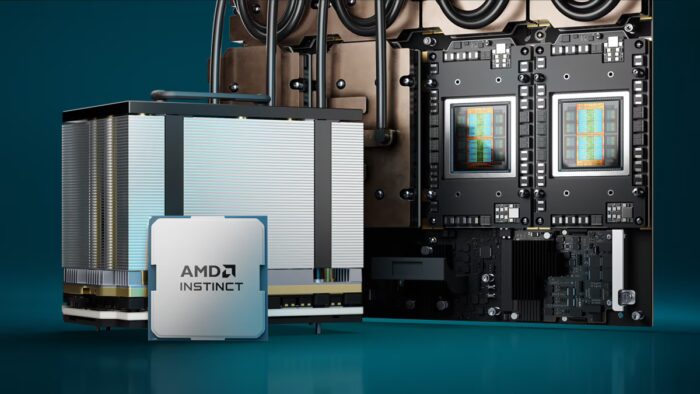
As enterprises refine infrastructure strategies, unified platforms are gaining attention. AMD has positioned its ecosystem to span multiple layers of the AI stack. AMD EPYC™ server CPUs support scalable data center performance across diverse AI and enterprise workloads. AMD Instinct™ GPUs advance AI training and inference in high-performance environments. At the device level, AMD Ryzen™ AI PRO processors bring AI capabilities to enterprise PCs with integrated security and manageability features.
The AMD Enterprise AI Suite extends this hardware foundation with a single open software layer that streamlines model deployment, resource orchestration, and lifecycle management across environments. This is especially attractive to organizations wary of proprietary lock-in or fragmented toolchains; open, modular infrastructure strategies offer operational flexibility alongside financial predictability.
In a landscape where AI infrastructure often represents the largest single cost center in digital transformation initiatives, unified design reduces friction. It accelerates rollout cycles, simplifies management overhead, and improves cost transparency.
1 IDC White Paper, sponsored by Supermicro and AMD, For a Solid Return on Investment with AI, Consider the Many Ways to Purpose-Fit Your Infrastructure, #US54076325, December 2025